Showing posts with label Montessori Monday. Show all posts

Montessori Monday Lovin Language!


Lovin Language!  What is the best method to teach reading, phonics or whole language?  This is a century old question and I will tell you what method Montessori teaches and why.  Let me first start off by saying that as much as I love Montessori math I LOVE the Montessori method of language instruction even more!  This method of teaching language is so complete and thorough that it not only teaches a child how to read but in the process they will become fluent readers and writers. 


Where do I begin?
Similar to Montessori math, language also starts out very hands on.  Children will learn to build letters and manipulate sounds to spell before they will actually write.  In doing so the child has a complete understanding of the letter and how it is used in the context of words instead of trying to memorize what a foreign symbol is. 


You start out by introducing sandpaper letters.
Sandpaper letters give children a tactile hands on experience with learning letters and sounds.  Here is a great post on living montessori now about sandpaper letters.

After you introduce sandpaper letters and sounds you can add activities to reinforce letter recognition such as sand writing, letter building, play dough, Melissa and doug puzzles, wikki sticks ect.


A sandpaper extension would be beginning sound objects.  Use small, interesting objects in conjunction with the sandpaper letters and place them in baskets for sound sets 1, 2 , 3, 4 and 5.  Everyone has a slightly different method of introducing letter sounds.  This is the method I use. 
sound set one:  m, a, t, s, p
sound set two:  b, c, r, f, e
sound set three:  h, i, d, g, n
sound set four:  j, o, k, l, u, w
sound set five:  x, v, z ,q, y 
As soon as they finish sound set one they can build, spell and read mat, pat, sat, tap, Sam, Pam, map, at and am. 

Also practice blending letters together by saying mmm-aaaa-t say it slow then tell them to say it fast, what does that spell?  Mat!
At this stage play games, games and more games!
Games are a "sneaky" way to reinforce learning without them knowing it.  A few games I like to play are: bingo, I spy, letter hunt and I have who has. 

What happens after they know the sounds?

The next step is the moveable alphabet and the pink series.  This is where it really gets exciting!  It is their opportunity to take the letters and sounds to build words  The first step in this process is to match 3 part cards with a picture and a word that matches the card with both the picture and the word, then they build the word.  

I start out with short a words the pink series is three letter short vowel words.  Continue teaching each set of short vowel words until you finally end with short u words.  Upon completion of this series your child will be able to fluently read CVC or short vowel words!  

What about sight words?
Remember that century old question I asked at the beginning?  Well here is your answer... BOTH methods are best.  In a Montessori language program we teach phonics in conjunction with whole language or sight words.  Sight words are not just words you can't sound out.  They are the most commonly used words in the English language.  I use the dolch list here.

After you teach each set of short vowel words introduce 10 sight words.  This is another area where you play games, games, games.  We have sight words be the magic word of the day.  We use funny voices such as (cowboy, valley girl, movie star and volcano) when introducing the sight words.  This makes it more interesting and fun.   A fun and educational DVD series that I use to introduce sight words is Let's meet the sight words. 

In our classroom and at home we have word wall set up.  Here is a picture of our word wall.  We use the word wall for writing workshop and sight word games.  We play sight word swat, race to the sight word, build a sight word and sight word art. 


By using sight words in conjunction with phonics it will speed up a child's fluency and they will enjoy reading much more!  Giving a child a love for reading is the gift that never stops giving. 

After the pink series is the blue series which is long vowel words and vowel combinations.  A program that uses a good systematic approach to this is primary phonics and they also include a teacher's manual that mirrors Montessori methods. 

BOB books is another great reading series for children and they also have itunes apps that are fabulous! Click here to view those. 

The last part of the reading series is the yellow or green series.  In this step the children learn blends and special sounds.  Allison's Montessori has sandpaper letters that I use to introduce this series.  Once your child has completed all of these steps he will be a fluent reader and enjoy reading!!!  My son is 5 and he reads at a 4th grade reading level because he learned with the Montessori Method starting at age 3.  

I hope this will be a useful guide on your quest to teach your child to read!  Listen to them read and read aloud to them often!

  Reading is the window to the unknown world.   

Rachel 


Practical Guide to Practical Life Montessori Monday


Caring for Plants
Practical Life is one of the things that sets Montessori apart from traditional school.  In a Montessori prepared environment the teacher carefully chooses activities to place on the shelves for the children to practice and eventually master.  The practical life shelves consist of “works” that foster independence in practical life skills and fine motor development.  
By teaching a child to serve food by themselves they are learning grace, hospitality and courtesy at a young age. 

A few of these activities may include: 
slicing, chopping, peeling, spooning, transferring, tonging, dusting, polishing, sewing, cleaning, stirring, mixing, sweeping, serving, dressing skills, animal care, hammering, care of self, care of plants, care of animals and pouring. 
The practical life shelves in the classroom can bring the most joy to a child.  All of the practical life shelves in my classroom are theme based and carefully planned to flow into extension activities.  The young child will naturally gravitate to practical life shelves.  It is exciting for children to have meaningful work just like mom and dad. 

As new works are introduced and rotated often it sparks new interest in the child.  Many of the practical life lessons are sequential and build up to mastery.  These activities are not only fun and educational for the child but it also helps develop a great sense of pride in accomplishment.  The practical life skills will stay with them for life. 

Here are some of the works we have out right now in our classroom.  Because most of my practical life works are theme based I am only going to show you a few now and you will see more as they are introduced with new themes. 
This is a slicing work we have out on our shelf right now.  The children slice the banana, then place it the bowl.  They then place toothpicks in the slices and serve the banana pieces.
This is a carrot peeling work.  Usually I have 2 kids working together one is peeling the carrots and one is chopping the carrots.  The one who is chopping the carrots will then serve the children at the snack table a little silicone muffin cup filled with carrot slices.
Carrot chopping fosters hand eye coordination, concentration and fine motor skills. 
Care of plants.  In this work the children are responsible for taking care of the living plants in our class.  I also do this at home with my own children.  They feed the plants just enough water, clean the leaves and remove dead leaves and flowers when necessary.  This produces a great sense of responsibility and care for the environment.  They are very good about noticing when a plant needs care and attention.  I do not even have to remind them!
Sewing.  Sewing is one activity that is definitely sequential and produces fabulous results.  This is step one after the child learns to thread a needle they learn the basic step of lacing and the movement it requires.  After they have mastered this step they move on to the next 4 steps of sewing until they eventually sew their very own doll!!  Even the boys love the sewing works.  It helps with fine motor skills, concentration and self independence.
Care of self.  This is one of our dressing boards found at discount school supply.  Care of self is also another sequential set of activities.  We have several dressing boards that are the basic steps to tying, zippers, lacing, buttons and snaps.  Once they have mastered the boards they move on to dress up items to practice more.  Finally, they practice on them self and have usually mastered the concept at this point.  We have charts to keep track of when a child has mastered a new care of self skill and they children a excited to have their names on those charts. 
Care of animals.  In our classroom we have a guinea pig, fish and tadpoles.  The helpers are responsible for feeding and caring for the animals.  The children love taking care of our animals and watching them grow.  Here is a picture of a little boy feeding "Roxie" a piece of celery.  He is giggling with delight. 
Care for the classroom.  We have trays out on the shelves that allow the kids to clean the classroom.  This one is a table cleaning work with shaving cream and water.  They love this work!
Cooking.  We do many cooking activities.  This is one where the children grind corn to make cornmeal.  We use the cornmeal to make cornbread muffins!

Preparing snack.  We have snack out family style and the children prepare their own snacks.  Here they are practicing spreading by spreading cream cheese on tortillas to make meat and tortilla roll ups.
Baking a cutting out cookies Click here for our unit on Gingerbread Men
Sequential Pouring excersises Pouring starts with two cups the same size and the children pour beans from one cup to the next.  The pouring items gradually get harder and we add water.  Shown here is a girl pouring from a tea pot into two cups.  This is a more difficult pouring work.  Click here for the link to this post

Sweeping into a dustpan, the childre dump the items in the cup onto a square on the floor.  They use the brush and dustpan to carefully sweep the items into the dustpan.  Click here for the link to this post

Crumbing a table is a fun and purposeful work for the children.  They use this small brush and dustpan to "sweep" all of the crumbs off the table after snacks and lunch.  Click here for the link to this post
Through out the year I will post more about our practical life activities.  I love teaching children how to read and understand math but practical life and social skills in the classroom and at home I believe are equally important! 
Happy Spring
Montessori Monday


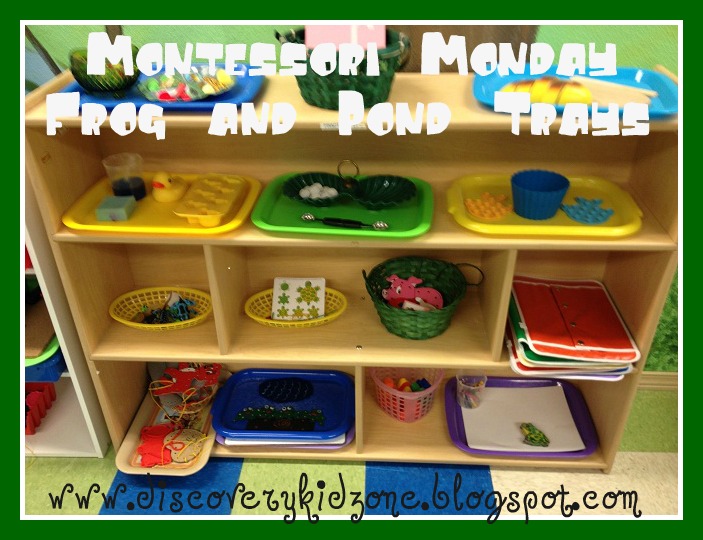
Montessori Monday Pond Trays


Montessori Monday

Frog Pond Trays

We are studying frogs and ponds this month.  For Montessori Monday I
wanted to do a post about our trays.  I get quite a few questions and
comments on where I get my items and how I set up my classroom.  I am
going to give you some tips on how to set up interesting trays in your
 classroom and at home. 
This is a duck dropper work, the child squeezes the dropper to fill up the blue water and then fills up every duck on the tray.  This builds fine motor skills and hand eye coordination.

Let me start off by saying that I was a preschool, Kindergarten teacher
 and mom all before I got my Montessori certification and became a
Montessori teacher.  The way I set up my school and homeschool reflects
 both backgrounds and I believe I have combined the best of both worlds. 

This is a pom pom transfer extension.  They have to use the tongs to transfer pom poms to the matching color frogs.  This is a build fine motor and math skills.
 First I start with a theme,  for example this month our theme is pond life. 
 Every month I go to the thrift store, target and the dollar store to
 constantly look for interesting trays and containers that can be used on
 work trays.  After each holiday and season I shop all the SALES!!  I
 have built up items over the years and now I have an abundance of things
 to choose from every month.  At the beginning of each year I make a
 scope and sequence to lay out what I want the kids to learn for homeschool
 and preschool.  I break it down into months.  Every month when I write my
lesson plans I use this as a guide and I fill out each individual child’s lesson
 plan to target those goals.  Here is where the fun part comes in!!  I
 search my items to look for works.  For example if I have kids who need
to work on operating a dropper I will look for fun ways to reinforce this
 skill with theme based items.  Every month when I put out the new works
 the kids are always waiting in anticipation to see what will be next and
 even if it is reinforcing the same skill it is packaged in a new way thus
making it more exciting! 
These are some of our language trays.  The first one is the 4 little speckled frogs.  They use the felt pieces to retell the song and story.  This reinforces language skills, counting, subtraction and sorting.
Next is draw and label a frog and sort the frog life cycle.


Here are some of our math trays, Lily pad addition using frog counters, frog sort and classify, frog counting with counters, frog patterns

Here are a few of our Practical life trays,
  frog egg transfer using small Styrofoam balls, operating a dropper duck pond, build a turtle with wiki sticks and our sewing basket.

 Some items that I always keep in stock to use are:

theme ice cube trays and silicone baking trays, Silicone shape baking cups, Colored trays, Theme erasers, Small
 plastic toys such as frogs, Water beads, Suction cup bath shapes, Marbles, Dollar store items for sensory box,
 Different colored and scented play dough , Theme based counters and letters, Theme
 based shape books made on the cricut, Crinkle paper, Medicine droppers, Various scoops and tongs from
Montessori Services, Theme based foam or felt shapes from Oriental Trading, Wiki Sticks , Pom Poms, Colored
noodles, Pipe cleaners, Letter and number beads
With these basic items you can make hundreds of fun work trays and change them often to keep it
fun and exciting!!
What new works did you make this week???

Rachel

I am linking up with living montessori now and what's on the tray wednesday

Montessori Monday <

Montessori Monday, Math Madness!!


Montessori Monday Math Madness

Why and How?

This week for Montessori Monday I decided to write about Montessori Math.  I wanted to tell you why I LOVE Montessori Math and how it works.

Why?


Let me start off by saying that I am TER I BLE at math!!  I just didn’t get it.  I am incredibly visual and kinesthetic and if you said to me what is the square root of sixteen I would look at you with a puzzled face and say what kind of plant makes a square root? Yep, it is that bad!  Well let me tell you that I went to high school and college and did not truly understand math until I was completing my Montessori certification and I had to figure out what the square root of the pink tower was that I finally had my AH HA moment!  You know the one where the light turns on and everything seems glorious?!  I finally could visualize math and how it works.  It is amazing that I literally had to go back to preschool to learn, but that is what it took.  Now I do understand math and I am thrilled to give kids that glorious AH HA moment at such a young age! 

How?
Montessori math is completely concrete and hands on!  No boring drills and flashcards.  You start with the basics and build on it through mastery.  This week I am going to talk about steps one through three.

The first step is the sandpaper numbers and counters.  I always introduce these concepts simultaneously in order to reinforce one to one correspondence.  This is a fun math activity because you can add different themed counters all year long! 


Start this math work as a sensory activity.  Have the child trace the number and then repeat in different sensory materials such as sand, rice or shaving cream. 
After they trace and repeat have them count the number of items they have traced. Mix the numbers up to reinforce number recognition. 


The second step in the Montessori math process is the number rods.  The number rods are a versatile tool that will be used all the way into kindergarten and beyond.  You start very basic by counting the colors on the rods.  You will then combine the number rods and sandpaper numbers followed by red and blue patterns.  After the child can successfully count to higher numbers they can make a number rod maze!!  They LOVE this activity and repeat it often.  Finally the number rods will be used for addition and subtraction!  Talk about a fabulous concrete math tool!! 

Geometry is the third step of math that is covered in the Montessori curriculum.  Constructive triangles are a tool that can be hard for even adults to complete however, with proper training and building concentration children as young as three can accomplish this task and with great joy! 
Constructive triangles come in a wooden boxes with multiple triangles in different sizes with a larger triangle to use a self correcting tool.  The children must match the colors and the black lines to make a larger trianle.  This work gets progressively more difficult and requires a great deal of concentration to complete. 

Never underestimate the mind of a young child.  It is truly an amazing thing!  They are an empty vessel and it is our job to fill them up!  Happy Montessori Math Madness day!  I am linking up with www.livingmontessorinow.com for Montessori Monday!  
Montessori Monday

Rachel