Showing posts with label discovery kidzone montessori school. Show all posts

Montessori Infant and Toddler Curriculum Part 2: Math and Language

This is part 2 in my Infant and Toddler Montessori Curriculum series.  I talked about sensorial in this post.  http://www.discoverykidzone.blogspot.com/2015/08/montessori-infant-toddler-curriculum.html
We are going to continue the series by discussing Math and Language.  Infants are always learning and it is exciting to watch and facilitate. 

Math
From day one infants are surrounded by math.  We ask what time it is, how old they are, how many ect.  Math is a very abstract and small children can’t understand the concepts.  They need to experience real objects in their environment to make the concept much more concrete.  Math begins with the realization of one and then more than one.  To witness a child evolving in this area is an amazing discovery.  Math activities for infants and toddlers can include:  Stacking and nesting cubes, number and block cubes, sorting and counting materials, matching and grading and sandpaper numbers. 


Language
From birth children are completely aware and are learning at an extremely rapid rate all about the human language.  Language is vital to the process of thinking.  The child needs to be spoken to, read to, sung to and listened to often.  Children need a broad exposure to language. 
Here are some song ideas:
Fuzzy Wuzzy Caterpillar Fuzzy, wuzzy caterpillar Into a corner will crawl. (squat and move to a corner) He’ll spin himself a blanket (move head in a spin) And then go fast asleep (pretend to sleep) Fuzzy, wuzzy caterpillar Wakes up by and by ( wake up, slowly move arms) To find he has wings of beauty Changed into a butterfly. (fly with arms)
Jack-in-the-Box Down in a box (squat to ground’ talk softly and slowly) There lives a little man. He waits and he waits, As quiet as he can Until I open the lid – POP!
Johnny Works With One Hammer Johnny works with one hammer, One hammer, one hammer, Johnny works with one hammer, Then he works with two. (repeat with 2, 3, 4) Johnny works with five hammers, Five hammers, five hammers, Johnny works with five hammers, Then he goes to sleep.
To aid the child in his language skill development the Montessori environment needs to be set up with literacy rich and language in mind.  Teachers and parents need to have books, pictures, picture labels, objects and matching pictures all thorough out the environment.
Click on the links below for book ideas for infants and toddlers:


You can find more infant toddler resources here:


 Thank you for visiting.  Let me know if you have any suggestions or comments. 
Rachel Supalla


Montessori Infant Toddler Curriculum Part one: Sensorial

The ages and stages of children vary greatly between each child.  We are all unique and special individuals.  As teachers and caregivers we play an important role to prepare the environment, follow the child, give simple lessons, observe exploration, foster concentration, document and be mindful of the chosen activities and learning outcomes.  All in all this will result in happiness and compassion towards others as the children have the opportunity to grow and learn in a harmonious environment. 
The question remains as to how do we set up such a desirable environment and how do we implement the activities that are planned?  In order to accomplish our goal we must remain focused on the center of our purpose and that is the child.  Imagine yourself as an infant or toddler.  How would you want your room to look?  What activities and materials would be fascinating to you?
An Infant and Toddler Montessori classroom is planned out by experiences.  Those experiences make up the curriculum and care of the child.  They will also build upon these skills as stepping stones to different developmental levels.  The experiences in an infant/toddler Montessori environment are:  Sensorial, Language, Gross Motor, Art, math and practical life. 
 
 
Sensorial Work
Sensorial is rooted from the words sense or senses.  These activities allow the children to focus on the fine tuning of all his senses.  Using all five senses the children will have a rich and meaningful learning experience. 

The purpose of sensorial work is for the infant and toddler to begin classifying his environment.  Maria Montessori wrote that all sensorial experiences begin at birth.  The young child becomes a sensorial scientist and by exploring his senses begins to understand and appreciate his surroundings. 
As we follow the child and learn their individual likes, dislikes and interests we can set up the environment with a variety of sensorial activities and experiences.  A few examples of sensorial activities for infants are toddlers are:  Water table filled with various liquids mixed with solids and real items (funnels, strainers, scoops, whisks ect), fingerpainting and other squishy activities, texture play and exploring, nature baskets, real item treasure baskets, shiny and crinkle objects such as foil and emergency blankets, sound tubes, animal sounds, food tasting and play, smelling jars, flowers, pine cone activities. 
I hope you are inspired to learn with your infants and toddlers.  I will post more about infant curriculum over the next couple of days.  Please let me know any comments or questions that you may have.

Rachel :)

Show me the money! Montessori money math!


Sensory math!  Sorting coins that are "hidden" in water beads.  


Show me the money!!  I mean really, who isn't excited about money?  Kids included.  It is natural for children to have a desire to learn about money.  It is a part of our everyday lives.  We should take this opportunity to teach them about something when their interest is high.  I like to introduce money around President’s Day.  We start with a discussion about Washington and Lincoln and that leads into learning about pennies and quarters.  

Another good time to build excitement about money is on St. Patrick’s Day when you can go on a search for the money at the end of the rainbow.  

This is when you can introduce the nickel.  We start with sorting coins, nickel , quarter and penny.  I use clear water beads and hide the coins to sort in the water beads.  After they have mastered that I add in the dime.  The next step after they have mastered coin sorting is to introduce the coin values. 

I do this by making it a Montessori counting work, I use sandpaper numbers to help reinforce the value of the coins and have objects to count to reinforce one to one correspondence.  
At the end of our money unit we celebrate with a PJ day and snack money store.  Each child brings in a snack and I pass out coins for them to count out to buy snacks.  

This was a fantastic learning experience and super fun to top it off!!  Have fun showing the kids the money! 


Montessori Inspired Writing Workshop


Hello All!  
It has been too long since I last wrote!  I just wrote a blog post for PreK and K sharing and you can find the post HERE.  I talked about how to start a writing workshop in a Montessori classroom.  The main thing is to instill a love of writing in a child at a very young age.  Writing can be a daunting task for children...and adults!  If you can find a way to make it fun and have meaning it doesn't feel quite so much like work.  

I think that in a preschool class having daily or weekly drawing workshops it teaches the children to draw with purpose.  Draw to tell a story.  This will get the child excited and begin the writing process.  Once the child is comfortable drawing with meaning then you add more complex steps such as labeling, writing a sentence using the labels and eventually a story.

Check out my post at PreK and K sharing and I promise I will write again very soon!  I have missed blogging and I am excited to be back!
Rachel Supalla


Montessori Monday Lovin Language!


Lovin Language!  What is the best method to teach reading, phonics or whole language?  This is a century old question and I will tell you what method Montessori teaches and why.  Let me first start off by saying that as much as I love Montessori math I LOVE the Montessori method of language instruction even more!  This method of teaching language is so complete and thorough that it not only teaches a child how to read but in the process they will become fluent readers and writers. 


Where do I begin?
Similar to Montessori math, language also starts out very hands on.  Children will learn to build letters and manipulate sounds to spell before they will actually write.  In doing so the child has a complete understanding of the letter and how it is used in the context of words instead of trying to memorize what a foreign symbol is. 


You start out by introducing sandpaper letters.
Sandpaper letters give children a tactile hands on experience with learning letters and sounds.  Here is a great post on living montessori now about sandpaper letters.

After you introduce sandpaper letters and sounds you can add activities to reinforce letter recognition such as sand writing, letter building, play dough, Melissa and doug puzzles, wikki sticks ect.


A sandpaper extension would be beginning sound objects.  Use small, interesting objects in conjunction with the sandpaper letters and place them in baskets for sound sets 1, 2 , 3, 4 and 5.  Everyone has a slightly different method of introducing letter sounds.  This is the method I use. 
sound set one:  m, a, t, s, p
sound set two:  b, c, r, f, e
sound set three:  h, i, d, g, n
sound set four:  j, o, k, l, u, w
sound set five:  x, v, z ,q, y 
As soon as they finish sound set one they can build, spell and read mat, pat, sat, tap, Sam, Pam, map, at and am. 

Also practice blending letters together by saying mmm-aaaa-t say it slow then tell them to say it fast, what does that spell?  Mat!
At this stage play games, games and more games!
Games are a "sneaky" way to reinforce learning without them knowing it.  A few games I like to play are: bingo, I spy, letter hunt and I have who has. 

What happens after they know the sounds?

The next step is the moveable alphabet and the pink series.  This is where it really gets exciting!  It is their opportunity to take the letters and sounds to build words  The first step in this process is to match 3 part cards with a picture and a word that matches the card with both the picture and the word, then they build the word.  

I start out with short a words the pink series is three letter short vowel words.  Continue teaching each set of short vowel words until you finally end with short u words.  Upon completion of this series your child will be able to fluently read CVC or short vowel words!  

What about sight words?
Remember that century old question I asked at the beginning?  Well here is your answer... BOTH methods are best.  In a Montessori language program we teach phonics in conjunction with whole language or sight words.  Sight words are not just words you can't sound out.  They are the most commonly used words in the English language.  I use the dolch list here.

After you teach each set of short vowel words introduce 10 sight words.  This is another area where you play games, games, games.  We have sight words be the magic word of the day.  We use funny voices such as (cowboy, valley girl, movie star and volcano) when introducing the sight words.  This makes it more interesting and fun.   A fun and educational DVD series that I use to introduce sight words is Let's meet the sight words. 

In our classroom and at home we have word wall set up.  Here is a picture of our word wall.  We use the word wall for writing workshop and sight word games.  We play sight word swat, race to the sight word, build a sight word and sight word art. 


By using sight words in conjunction with phonics it will speed up a child's fluency and they will enjoy reading much more!  Giving a child a love for reading is the gift that never stops giving. 

After the pink series is the blue series which is long vowel words and vowel combinations.  A program that uses a good systematic approach to this is primary phonics and they also include a teacher's manual that mirrors Montessori methods. 

BOB books is another great reading series for children and they also have itunes apps that are fabulous! Click here to view those. 

The last part of the reading series is the yellow or green series.  In this step the children learn blends and special sounds.  Allison's Montessori has sandpaper letters that I use to introduce this series.  Once your child has completed all of these steps he will be a fluent reader and enjoy reading!!!  My son is 5 and he reads at a 4th grade reading level because he learned with the Montessori Method starting at age 3.  

I hope this will be a useful guide on your quest to teach your child to read!  Listen to them read and read aloud to them often!

  Reading is the window to the unknown world.   

Rachel 


Tell me a Story Tuesday! The Cat in the Hat!


Tell me a Story Tuesday!

The Cat in the Hat!

It is Dr. Seuss week!  Every day this week we will read a different story by Dr. Seuss and do activities to go along with that book.  Today we read The Cat in the Hat and The Cat in the Hat comes back!
For art the first thing we made was Thing one or Thing two.  This was a fun activity because we also were able to create homemade puffy paint!! 


First you add glue to a cup, next you add paint and stir it up good!  Finally you add shaving cream and stir again.  Keep adding shaving cream until the concoction is nice and fluffy!  This was super fun and super easy!


The kids traced their hands and cut them out.  They added their hands to the red bodies.  They drew the faces and wrote thing one or thing two on the belly.  Then they painted the blue puffy paint for hair.  When it dried it was still puffy! 

We had two art stations today they could make one or both.  The other station was a simple cut and paste cat in the hat.  This was a following directions craft. 

For snack we made cat in the hat treats.  We stacked red gummy lifesavers and frosting on ritz crackers to make a cute little hat.

We did a brain storm on what activities we could do on a rainy day.  Tomorrow we will use that brainstorm for writer’s workshop.  Since the book started out as a rainy day, we used that opportunity for a science experiment.  We talked about the water cycle and where rain comes from.  Our experiment was a visual of rain coming from the clouds.  I filled up clear cups about ¾ full.  On top of the water I allowed each child to squirt shaving cream.  This was our cloud.  I went around and dropped blue food coloring on top of the shaving cream and the kids were able to watch it “rain” in their cups.
Here are a few pictures of the other activities we did today! 
Cat in the hat following directions and reading game

Today I will post about Wacky Wednesday and Oobleck!  I am really enjoying reading about all of your Dr. Seuss adventures this week!

 I am linking up with www.livingmontessorinow.com for their Happy Birthday Dr. Seuss Linky party!  I am also linking up with living life intentionally


Rachel /


President's Day Activities


President's Day Activities
This week we are studying President's day and we are celebrating George Washington and Abraham Lincoln's Birthdays.
We started out with the movie Getting to know Abraham Lincoln (click below for a preview) and a song we also did a movement activity where we started out small and grew taller and taller like Abe Lincoln. 
Here is the Presidents Song we sang.

 Last week we also learned about Abraham Lincoln. We talked about how tall he was and I decided this would be a great estimating and measuring project. The first thing we did was have the kids all estimate how tall they thought Abraham Lincoln was. After that we measured how tall he actually was, and drew him paper.  The kids were so excited to see how tall he was and wanted to see how tall they were in comparison.  They got to lay down and we measured with the measuing feet.  The kids counted the feet and inches on thier own and I recorded their answers.  When all the kids got a chance we hung him up on the wall and even the teachers were able to record their heights! 
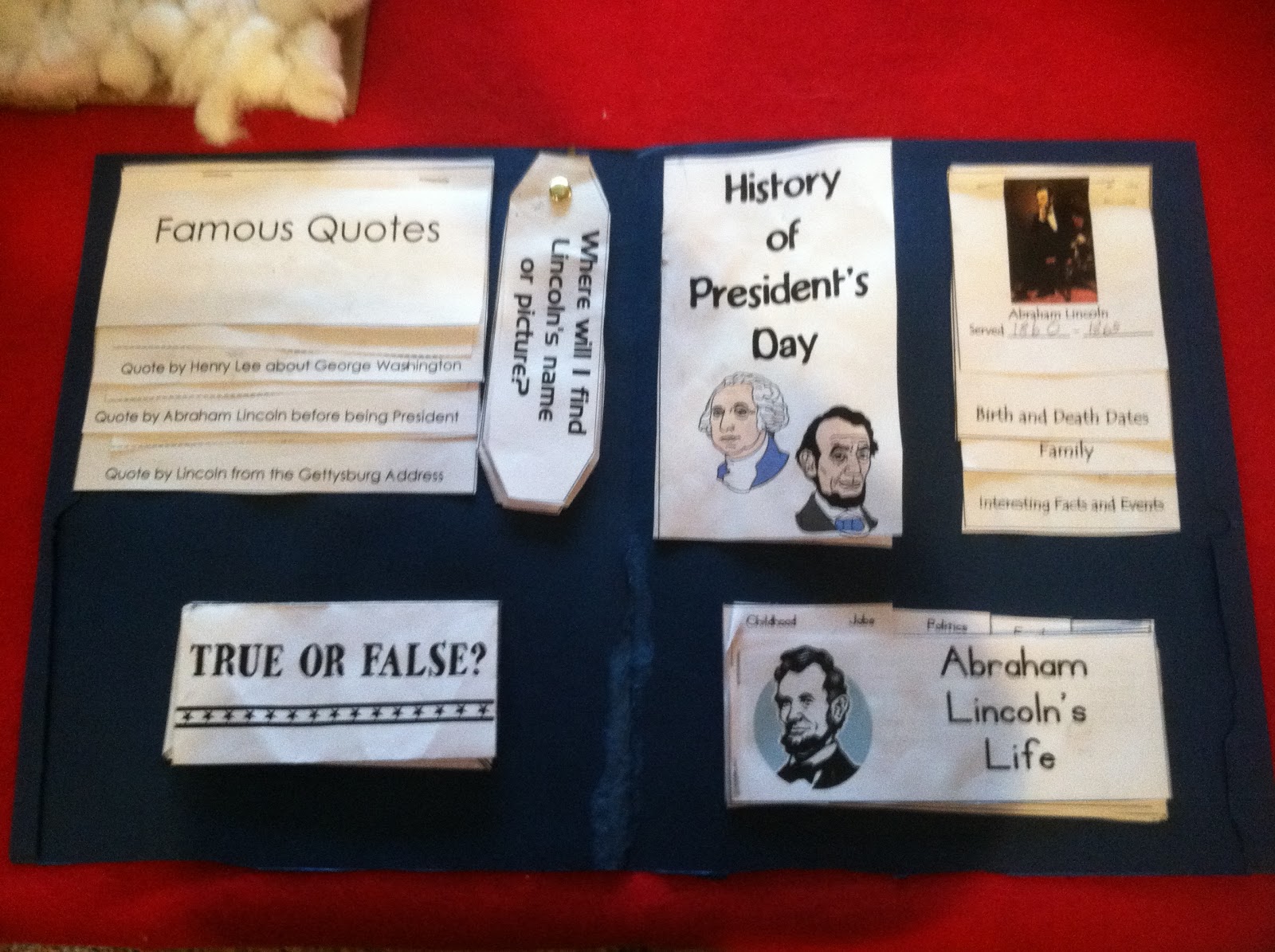
We made George Washington and Abraham Lincoln lapbooks to review all we learned about president's day. 
We made George Washington and Abe Lincoln portraits for the covers of our lapbooks.
The kids drew their own faces!  I was impressed!!  :)

We made log cabins out of sticks.

For snack I bet you can guess what we had....Log cabins!! 
We used a graham cracker for the base and cream cheese for the glue.  A few of the kids used a small pretzel for the window!  So creative!  I have also done this with the pretzel rods and peanut butter. 
 Our math activities this week are all about money math!  We learned about the quarter and we counted by ones to 25 and counted by 5's to 25.  Also we sorted money and made money patterns.  The older kids did basic money adding and matching sets.  (sorry I didn't take pictures of our math activities) 
For art we will make quarter and penny rubbings, Lincoln and Washington portraits, Cherry tree handprints with tissue paper cherries and cherry pie baking.  
For the cherry pie you just put cherry pie filling in a 9X13 pan and put bisquits on top of the pie filling.  Dap the top with butter and bake at 350 for 20 min.  I will post pictures later this week.

On Wednesday we will do a science experiment with pennies.  What liquid will clean a penny best?? 
Our languge lessons will be based around our first 25 sight words on president silloettes and the "ig" family as in wig.  I am excited about the wig ideas I have this week, I have about 15 wigs I am bringing to school and the kids will get the opportunity to sort CVC words and if they rhyme with wig they will run and place them under their wig.  The read aloud book we are reading this week is:
Abe Lincoln at last

We will finish the week by making powder wigs and acting out a president's day poem as I read it. 
 Here is my February Pinterest Board for more President's day ideas! Kidzone Teacher Mama Feb Pinterest Board
Like most Americans, I truely admire the integrity and hard work these great men have done for our country.  They set a standard that is hard to come by these days.  I think it is important to teach children about the high standards that were so important to these men.  I want my children to have a good example to model. 
I hope you found some ideas you can use in your classroom or at home with your own kids.